Friday, May 11, 2012

Three Major Themes

The three major themes that connect various topics in this course are amino acids and proteins, nucleic acids, and glycolysis.
Nucleic acids are major topic of this course.  Our body is made up of many complex processes, molecules, structures which code for specific functions. Nucleic acids are the material that makes up part of the DNA. From previous knowledge it was understood how nucleic acids pair with eachother, but in this class the over all structure made it more clear. How the nucleic acids are attached to the backbone and the strcture of the whole nucleotide was very interesting. The structure of DNA made more sense after understanding nucleic acids and nucleotides. The over all structure of DNA is important to understand because it is the instruction manual for the cells in the body.
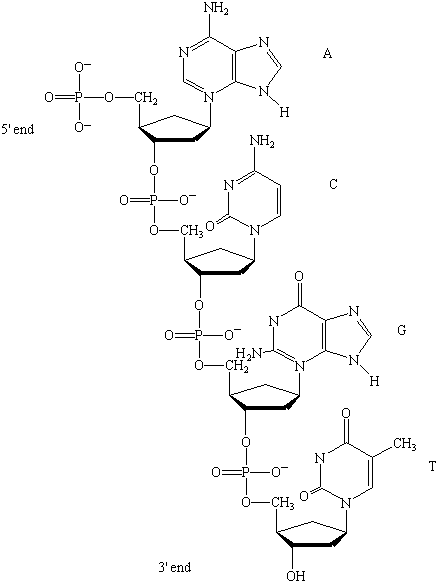
(Google)

Amino acids and proteins are another major topic in this course. There are 20 common amino acids which make up proteins in the process of translation. The body needs the right amino acid in order to make a specific protein. Amino acids and proteins are one form of how genetic information is expressed in order to perform specific tasks. For example, amino acids code for a protein that is needed to catalyze a reaction in our cells. In this course, greater knowledge is gained of how important every little detail is to our cells. The understanding of what makes up a protein helps connect why a protein might be denatured and how that denaturation causes diseases.

(Google)


Glycolysis is the third major topic that was covered in this class. Glycolysis is the first step in the process of making ATP. It provides the cell with the energy to perform specific tasks that are needed in the body. The information in this class made it clear how efficient the body is in making and using energy.

 (Google)


Thursday, May 10, 2012

How would you explain the connection between glucose entering the body and energy created by the body to a friend, using your new biochemistry knowledge.

Carbohydrates are a major food source which energy is derived from. One type of carbohydrates is glucose. When glucose enters our body it undergoes a metabolic pathway called glycolysis, which means breaking glucose apart. Glycolysis is the process that your cells undergoe to breakdown glucose and make energy. One molecule of glucose is broken down at a time which produces two molecules of pyruvic acid. Many oxidation reactions occur during this process and the energy released is used to form ATP. The initial step involves two phosphates which attach to glucose. Then the glucose with a phosphate at each end splits into two three carbon molecules. Then each of the three carbon molecules undergoes through multiple steps to convert into pyruvate. During this step electrons are transferred to the coenzyme NAD+ to form NADH and ATP is formed. In aerobic conditions the pyruvate is oxidized further to make more ATP and under anaerobic conditions the pyruvate is converted into lactic acid. There is 4 ATP’s produced in glycolysis, but only a net gain of 2 ATP’s.

                                   First step in Glycolysis
                                                       (Google)

Second Step in Glycolysis
                                                                           (Google)

Tuesday, April 17, 2012

What knowledge have you connected with past knowledge?

The replication of DNA is a very unique and important process. Understanding the components of the DNA is a huge part of understanding how it works. It was said in every biology class that DNA replicates from 5' to 3' but it was never clear why. In biochemistry, the understanding of nucleotides and the molecules on each end puts everything together. The sugar phosphate backbone contains a 5' end that has the free phosphate group. The 3' end contains a free O- group. DNA polymerase can only add a nucleotide on the 3' end that has the O-. As DNA and RNA replicate, the 5' C end of a nucleotide will attach to the 3' C end of another nucleotide by a phosphodiester bond. Also the differences between DNA and RNA were more clear as knowledge was gainded in biochemistry. RNA contains an OH group on the 2' C and DNA contains only an H on the 2' C. The basic understanding allows scientists to manipulate DNA in our favor as well as move forward in research for new information.

Thursday, March 1, 2012

Find an interesting biochemistry website and put its link in this entry, and describe what is found there.

This is a website with interactive concepts in biochemistry. As you go through the website, you will find a lot of topics that we talked about in class.This website shows chemical structures and concepts through animated tutorials. There is an amino acid game to help recognize their structures. Also you can test your knowledge by taking quizzes offered on the website. Another interesting section is called cutting edge. This section connects biochemistry with real life. Also included in this website is protein folding, protein synthesis, enzyme inhibition and a lot more. In addition to biochemistry topics, there are other web links which have other scientific concepts.
http://www.wiley.com/college/boyer/0470003790/animations/animations.htm

Thursday, February 23, 2012

What knowledge have you connected with past knowledge?

"Structure determines function" is an important phrase that has been said in many biology classes. Most evidence of this is studied in diseases that are caused by denatured and misfolded proteins. For example Alzheimer's disease, Huntington's and Parkinson's are a result of misfolded proteins. This means that the code for a specific protein on the genetic sequence was not normal which resulted in a disease. The structure of the protein was altered and the function of that protein changed to cause harm in the body. Other examples may include the denature of enzymes which causes them to not do their job and not bind to their specific substrate. This would also cause the body to loose the ability to catalyze a reaction. The active site on a denatured enzyme is not normal therefore the substrate can not bind to it which would change the enzymes function.

Thursday, February 16, 2012

Find a protein using PDB explorer-describe your protein, including what disease state or other real-world application it has.

Amyloid beta-peptide (Abeta) is derived from the amyloid precursor protein. This protein is found in the synapses of neurons and helps with the growth of the neurons. When the amyloid precursor protein breaks down into amyloid beta-peptides, it becomes an issue because they can build up in the brain and cause Alzheimer's disease (AD).  The Abeta is a beta-peptide fragment with a length of 42 amino acids. When the amyloid beta-peptide breaks apart from the protein, it changes shape and and turns into a long fibril. The fibrils than turn into plaques and as they build up, they cause neuronal damage which leads to AD.

Wednesday, February 8, 2012

What is BioChemistry, and how does it differ from the fields of genetics, biology, chemistry, and molecular biology.

Biochemistry is the study of living organisms and their chemical processes which determines their function. Biochemistry has many branches to it. It is the base of  life sciences and brings them together on a chemical level. The study of biochemistry consists of all the cellular chemical processes that undergo cellular respiration, photosynthesis, protein synthesis,etc. Genetics differs with biochemistry because genetics focuses more on the hereditary component of living organisms. Genetics explains the inheritance of characteristics and genes of living organisms. Biology differs from biochemistry by not focusing on the chemistry part. Biology explains the living organism as a whole and it's interactions with their surroundings. Chemistry on the other hand differs from biochemistry by focusing more on the chemical processes that occur between molecules all around us. Molecular biology is the study of macromolecules that are needed for life, like proteins. It differs from biochemistry because it focuses more on the mechanisms of protein synthesis and replication of genetic information. In conclusion, biochemistry is essential in living organisms and the natural processes they undergo.